Showing posts with label jBPM6. Show all posts

Tuesday, October 25, 2016

jBPM 6.5.0.Final available

While we have been working on jBPM v7 for quite a while now, we still wanted to deliver a few more features that were requested by users.

You can find all information here:

Ready to give it a try but not sure how to start?  Take a look at the jbpm-installer chapter.

So on top of a bunch of bug fixes, you can expect the following new features:

Core Engine

Process instance migration

Process instance migration allows you to upgrade an already active process instance to a newer version of the process definition (than the one it was started with). Optionally it allows to perform node mapping of active node instances within process instance (to accommodate for use cases where currently active nodes might have changed).  The jBPM services have been extended with a new more powerful API and the same functionality is available remotely through the kie-server API.
JMS interaction patterns
When using the remote API of our kie-server, the JMS version now also supports different interaction patterns (on top of the request-response already supported):
  • fire and forget
  • asynchronous with callback
Task variables support in listeners

Added operations to easily get access to task variables from within task listeners.

Remote API improvements for deployments

Additional operations have been added to the remote API to simplify integration: operations to get deployment information of your projects based on their group, id and/or version (GAV).


Process Designer

Improved automation importing service tasks in Designer

You can import custom service tasks from a service repository into Designer so they can be used in your process, like for example Twitter, FTP, etc. The workbench now automates a lot of the additional configuration as well:
  •     Installs the service configuration (wid) into the users Workbench project
  •     Installs the service icon (defined in the service configuration)
  •     Installs the service maven dependencies into the project POM
  •     Installs the service default handler into the project Deployment Descriptor
Using start up parameters, you can also register a default service repositories and even install service tasks by default for new projects. More details are available in the documentation.

Copy/Paste

You can now also perform copy/paste operations across different processes.


Workbench

Using workbench and kie-server together

Various small improvements allow you to use the workbench together with (one or more) kie-server execution servers to manage your process instances and tasks (sharing the same underlying datasource). As a result, processes and task created on one of the execution servers can now be managed in the workbench UI as well.

The jbpm-installer is now configured out-of-the-box to have a managed kie-server deployed next to it where you can deploy your processes to as well.

Support for enums in data modeler
The data modeler now supports selecting enums as the type when defining the parameters of a data object.


Upgrades

Various components have been added / upgraded:
  • Upgraded to WildFly 10
  • Added support for EAP 7
  • Upgraded to Spring 4
The jbpm-installer now uses WildFly 10.0.0.Final as the default. 
Enjoy !

Monday, September 28, 2015

jBPM 6.3 released

jBPM 6.3.0.Final has been released !

In this release we focused on bringing a bunch of (typically smaller but powerful) features that our users were asking for.  A quick highlight is added below, but full details can be found in the release notes.

To get started:
Downloads
Documentation
Release Notes

Ready to give it a try but not sure how to start?  Take a look at the jbpm-installer chapter.

jBPM 6.3 is released alongside Drools (for business rules), check out the new features in the Drools release blog.
Thanks to all contributors! 


Core engine improvements
  • Support for JavaScript as script / constraint language in processes
  • Asynchronous processing improvements, including
    • the (re)introduction of asynchronous continuation (where you can mark a transition as to be executed asynchronously in a separate transaction)
    • ability to mark signal throw events as asynchronous
    • jbpm-executor (our asynchronous job executor) got configurable retry mechanisms and improved performance due to new JMS-based triggering
  • Signal scopes for throwing signal events, so you can better decide who the event should be sent to (process instance, ksession, project or external)
Configurable and extensible task and process instance list
  • Custom filters:
    The process process instance list and task list in the workbench can now be configured even more by the end user by adding custom filters.  This allows you to create new tabs that show a subset of your tasks (or process instances), based on parameters you decide yourself.
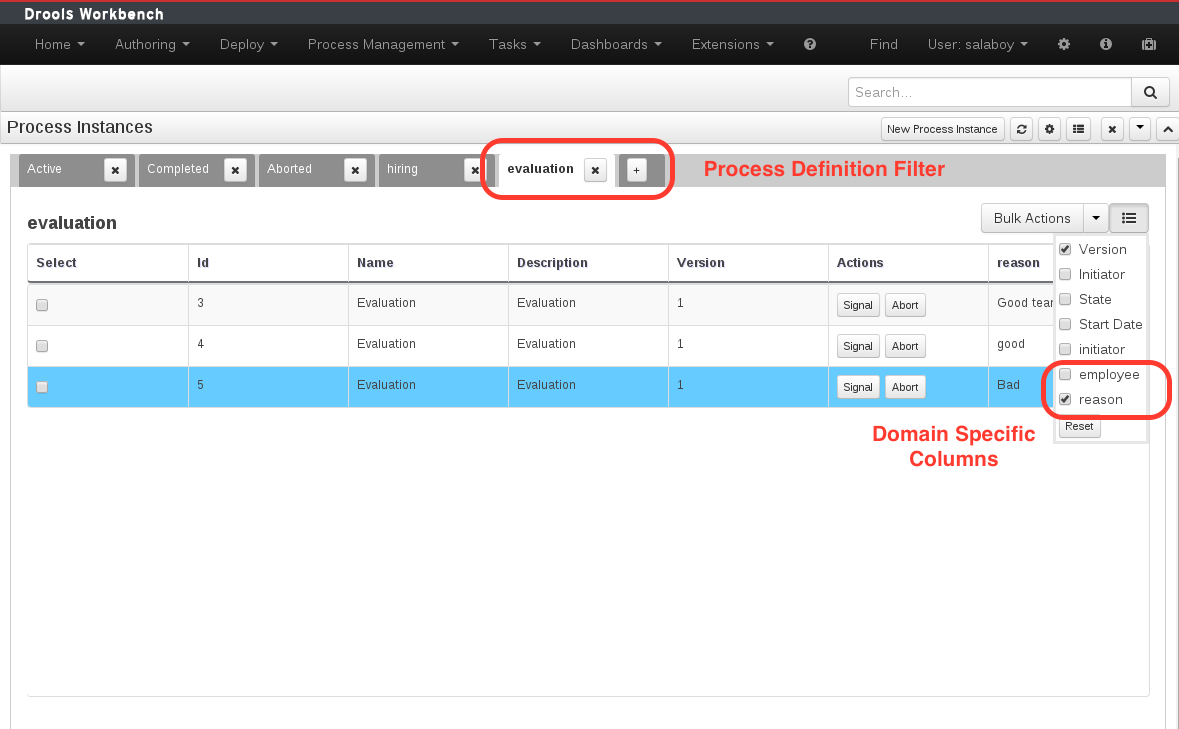
  • Domain-specific columns in the process instance list
    You can show now show (domain-specific) data related to the process instance variables in the process instance table directly, by creating a custom filter that restricts the data to one specific process.  Doing this allows you to then add domain-specific columns: additional columns can be added to the table that show the value of variables of that specific process.

Data mapping in Designer

When you have a lot of data being managed in your process, defining the data flow among all the nodes can become pretty complex.  A new data mapper has been added to Designer to simplify this task: it has the ability to do all you might need in one place (like adding new data inputs / outputs while you've already started doing the data mapping) and simplifies data assignments (either by giving a direct value or by mapping an existing variable).


Embeddable process / process instance image 

New operations were added to the remote API to allow retrieving the process image or annotated process instance image (showing which nodes are active / completed).  This image is similar to the one you were already able to access inside the workbench already, but is now also available remotely for embedding in external applications.


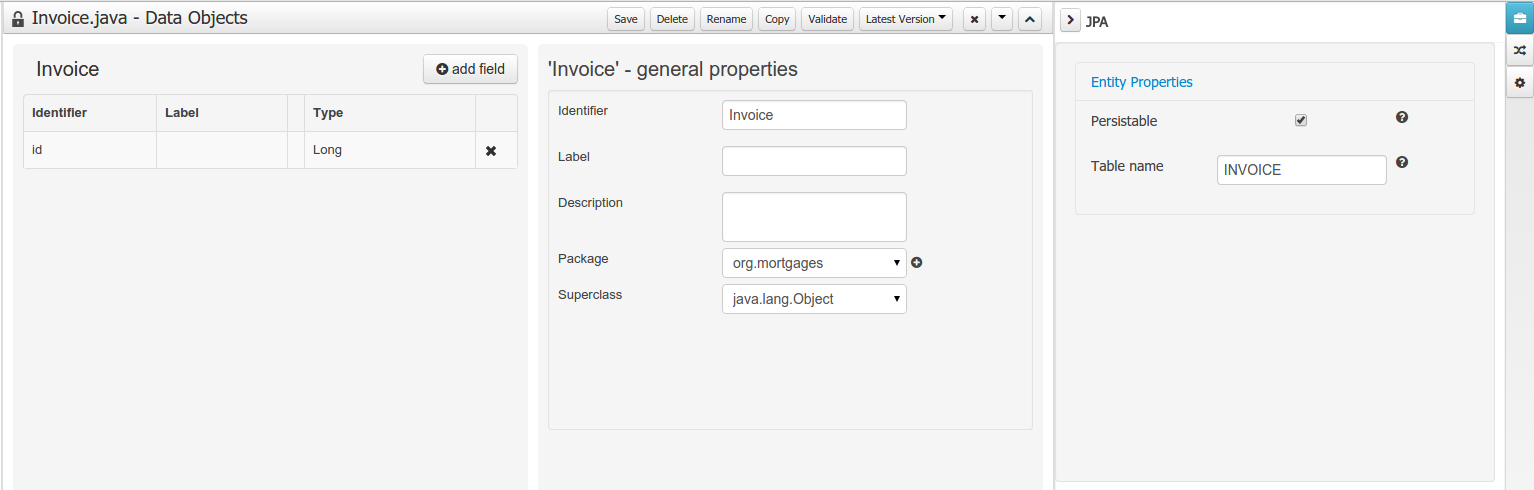
JPA support in the Data Modeler

The data modeler in the workbench now also exposes properties that allows you model a data object as a JPA entity.  When a data object is modeled as a JPA entity, it is not stored as part of the process instance state but stored in a separate (set of) database table(s), making it easy accessible from outside as well.

Case management API

The core process engine has always contained the flexibility to model adaptive and flexible processes. These kinds of features are typically also required in the context of case management. To simplify picking up some of these more advanced features, we created a (wrapper) API that exposes some of these features in a simple API: process instance description, case roles, ad-hoc cases, case file, ad-hoc tasks, dynamic tasks and milestones.

Support for these features in our workbench UI is being worked on for version 7.0.

Unified execution server

A lot of work went into the creation of unified, highly configurable, minimal execution server - ideal for cloud-based or micro-services architectures.  Since v6.0 the workbench has included an execution server that could be accessed remotely.  This was however embedded into the workbench and designed to operate in a symmetric way when deployed in a clustered environment (all nodes in the cluster were able to execute all processes / requests).  In Drools v.6.2 a new minimal decision service was introduced that allows only deploying specific rule sets to specific containers, giving the user full control over deployment.  This has now been unified, resulting in a lightweight execution server where you can execute your processes, rules, tasks and async jobs.  It can be set up as a single execution server for all your projects, or different execution server instances (possibly one for each project).

Wednesday, July 22, 2015

Book: Mastering jBPM6

A new book was published about jBPM6, targeting the latest 6.2.0.Final release.  I haven't been able to review the book yet (I will add details to this blog if I get the chance to), but wanted to share this opportunity already.

(Click on the image to go to the publisher website)

Tuesday, April 28, 2015

jBPM on Red Hat Summit / DevNation

From June 21st - 26th, Boston will be the place to be for the Red Hat Summit and DevNation 2015 conferences.


This year, I'll be presenting two sessions on Summit:

Process-driven application development using Red Hat JBoss BPM Suite
Kris Verlaenen — jBPM Project Lead, Red Hat
Wednesday, June 24 (10:40 am - 11:40 am)

Enabling business users to update their applications and processes is an integral part of business automation. Doing so requires rich client web technology and a powerful workbench to customize and extend business rules management (BRM) and business process management (BPM) solutions.

Red Hat JBoss BPM Suite is a flexible and powerful BPM platform, offering business process modeling, execution, and monitoring capabilities for numerous use cases. It can be used in different environments, and, as a result, the platform can be integrated in multiple architectures and configured in detail. The platform can be customized to provide customer-specific enhancements.

In this session, you will:
  • View a live process-driven application demo.
  • Discover the top technical things you need to know about the latest version of JBoss BPM Suite.
  • Get answers to some of the most asked questions.
  • Learn the truth about BPM myths.
  • Find out what’s next for JBoss BPM Suite.

Continuously improve your processes with Red Hat JBoss BPM Suite
Kris Verlaenen — jBPM Project Lead, Red Hat
Thursday, June 25 (1:20 pm - 2:20 pm)

Business process management (BPM) lets your business operate smoothly and in a controlled manner. But to get the results you want, you have to be willing to continuously improve your processes. Join us to see how jBPM and Red Hat JBoss BPM Suite help you continually improve your processes.

We will explain and demo how to:
  • Collaborate on designing processes.
  • Manage your processes using multiple repositories and projects.
  • Promote business assets (from development to production).
  • Execute different versions of your processes in parallel spaces.
  • Perform process instance migration.
  • Implement a new functionality as a process. 
[Credits for this proposal go out to Maciej, who did most of the work]

I won't be presenting on DevNation this year, but I'll definitely be around as well, for some late night coding and if necessary some beers :) Let me know if you're planning to attend and would like to meet up at some point !

There will be numerous other interesting Summit presentations where jBPM will be involved as well, for example:
And a lab as well, on integration with Fuse:

Thursday, April 23, 2015

JBoss BPM Suite v6.1 available

Last week, Red Hat annouced the official release of JBoss BPM Suite v6.1. This brings you (almost) all of the new features that came in jBPM 6.1 and 6.2 into the supported offering.

You can take a look at the release notes of jBPM 6.1 and jBPM 6.2 to see all the details, but at a (very) high level this for example brings you new features:
  • Document attachments: attach documents to forms and manage them in your processes
  • Embeddable forms: embed process and task forms in your own application
  • Remote EJB + WS interfaces
  • Camel service tasks
  • Social features: profile page, follow other people using event streams, etc.
  • Customizable workbench: extend the workbench web UI with your own views
  • Asset management [Tech Preview]: manage assets moving from a development branch into a production branch before being pushed into production
  • Certification on top of EAP 6.4, WebLogic, Fuse and Java8
A lot of effort was also put into stabilizing and improving existing features.

Since JBoss BPM Suite is a super-set of JBoss BRMS, you get an integrated solution that offers  support for your business rules, complex event processing and optimization problems as well (based on Drools and Optaplanner v6.2).   This for example introduces a new 'realtime decision server' as part of BRMS 6.1.

If you want to know more, take a look at the following page:
http://www.jboss.org/products/bpmsuite/overview/

Eric also posted a blog with some more details and a bunch of examples to get started !

Below are some slides that list most of the features.

Friday, March 6, 2015

jBPM 6.2.0.Final released

The bits for the jBPM 6.2 release are now available for you to download and try out!  

Version 6.2 comes with a few new features and a lot of bug fixes !  New features include a.o. EJB, (improved) OSGi and Camel endpoints support, a new asset management feature (to introduce a development and release branch and promote assets between both), social profiles and feeds and the ability to extend the workbench with your own plugins!

More details below, but if you want to jump right in:

Downloads
Documentation
Release Notes

Ready to give it a try but not sure how to start?  Take a look at the jbpm-installer chapter.

jBPM 6.2 is released alongside Drools (for business rules) and Optaplanner (for planning and constraint solving), check out the new features in the Drools release blog, including a brand new rules execution server and the Optaplanner release blog as well.

A big thank you to everyone who contributed to this release!

Some highlights from the release notes.

Core services

  • EJB: the jBPM execution server (that is for example embedded in our web-based workbench) now also comes with an EJB interface.  A refactoring of the underlying jbpm-services now makes the execution services accessible using pure Java, CDI, EJB and Spring. Remote interfaces using REST and JMS are still available as well of course !  A lot more details are described in Maciej's blog here.
  • Deployments (defining which versions of which projects are currently active in the execution server) are now by default stored in the database.  This greatly simplifies the architecture in a clustered environment in case you are only using our runtime side of our web tooling (for example by having dedicated execution servers in production).
  • Our asynchronous job executor has improved support for requeuing failed jobs and for recurring jobs (e.g. daily tasks).
  • OSGi: Full core engine functionality is now available on top of OSGi.  A significant number of additional jars (including for example the human task service, the runtime managers, full persistence, etc.) were "OSGi-fied". Specific extensions and tests showing it in action are available for Apache Karaf and Aries Blueprint (in the droolsjbpm-integration repository).
  • Camel endpoint URIs: A new out-of-the-box service task has been implemented for using Apache Camel to connect a process to the outside world using some of the numerous Camel endpoint URIs. The service task allows you to for example specify how to pass data to an FTP endpoint by configuring properties such as hostname, port, username, payload, etc. for some common endpoints like (S)FTP, File, JMS, XSLT, etc. but you can use virtually any of the available endpoints by defining the URI yourself (http://camel.apache.org/uris.html).

Workbench
  • Form Modeler comes with improved support for adding custom logic to your forms using JavaScript on changes, and support for configurable ComboBox and RadioGroup fields, and simple List types.
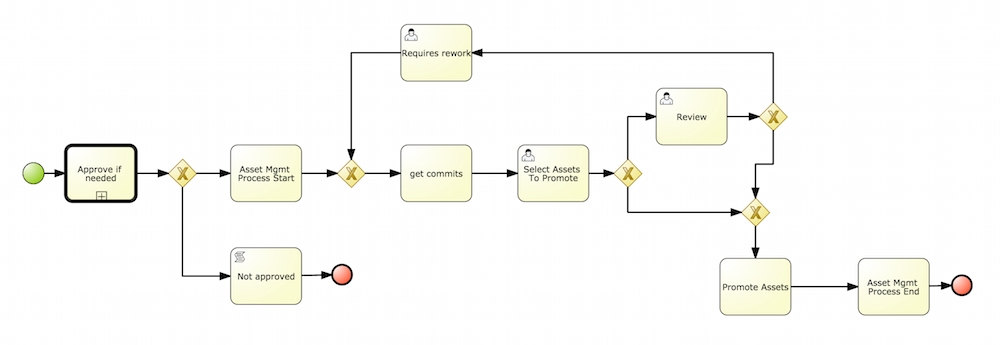
  • Asset management: It is now possible to make a repository a "managed repository".  This allows you to split up a repository in multiple branches, one for doing development and on for releasing.  Users can then request various assets to be promoted to the resource branch when ready.  This promotion process, and the linked build and deploy processes, are defined using a BPMN2 process as well and include approval and build tasks.  Check the documentation for more details.

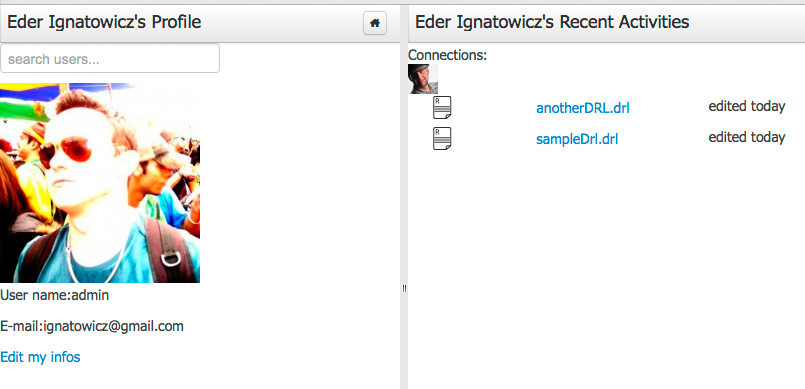
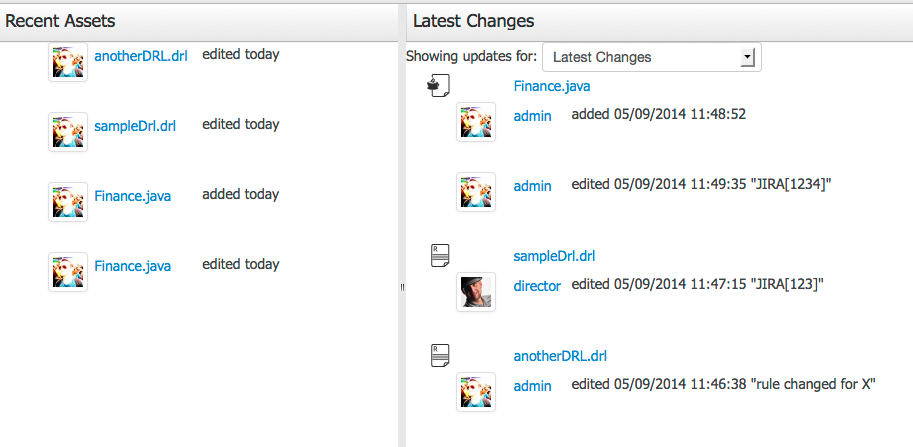
  • Social features, like user profiles (including gravatar pictures), and various event feeds like the most recent assets you worked on, on recent changes by other users.


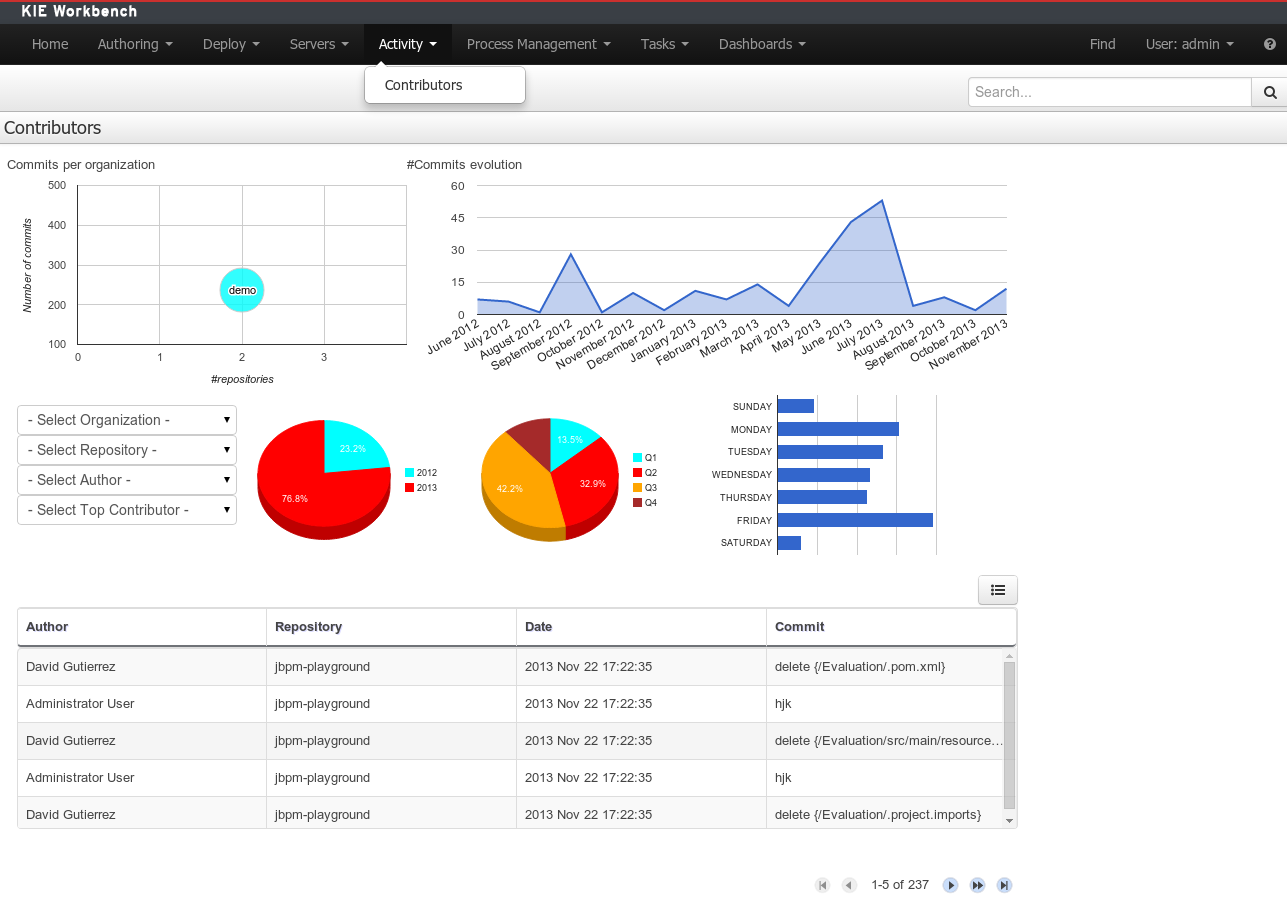
  • Contributors perspective is a new out-of-the-box report (using the new dashbuilder technology) that gives high-level insight in who is changing what in your repositories.
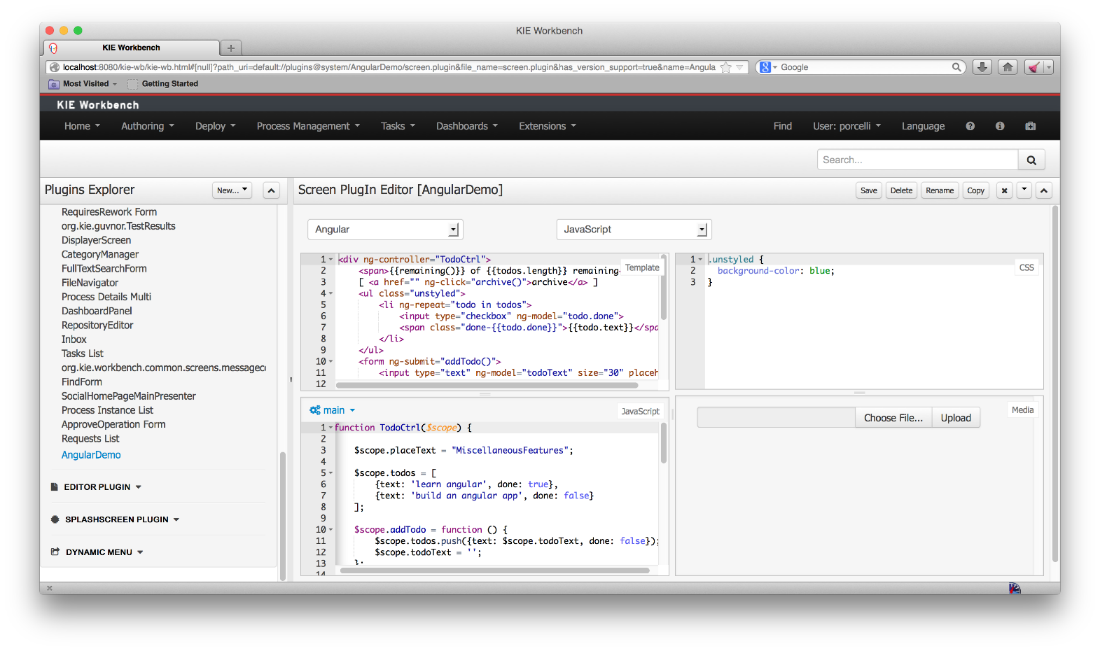
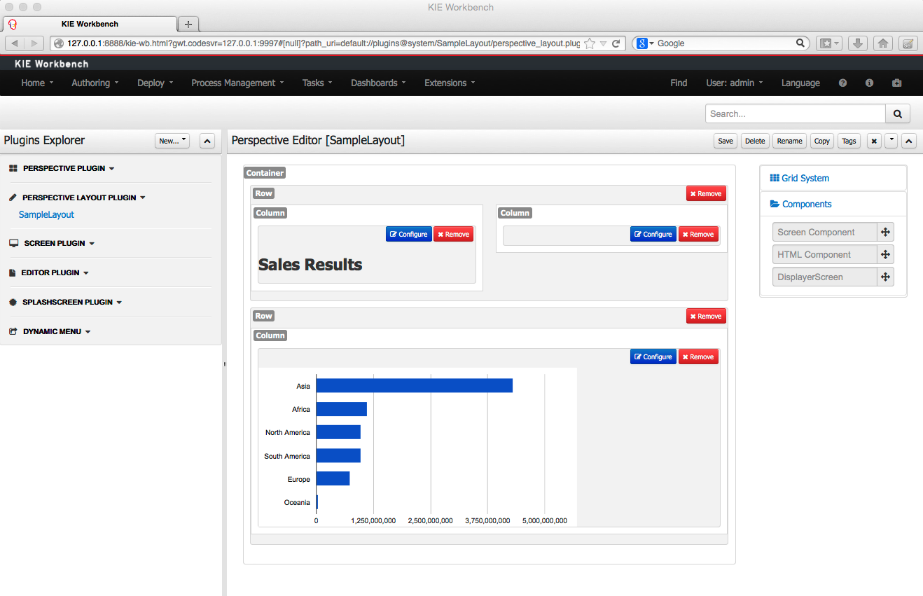
  • Pluggable workbench:  you can now extend the workbench with your own views, menus, etc. using workbench plugins. Available features includes creation of perspectives via a programmable or a drag and drop interface, create new screens, editors, splashscreens and dynamic menus. 

Wednesday, January 7, 2015

jBPM at DevConf 2015

Maciej reports that he'll be presenting at DevConf 2015 in Brno:
I am happy to announce that a talk and workshop about jBPM 6 has been accepted at DevConf 2015 in Brno.

Talk: jBPM - BPM Swiss knife

During the presentation jBPM will be introduced from the Process Engine & framework perspective.The main goal of the session is to share with the community of developers how they can improve their systems implementations and integrations by using a high level, business oriented methodology that will help to improve the performance of the company. jBPM will help to keep the infrastructural code organized and decoupled from the business knowledge. During the presentation the new APIs and new modules in jBPM version 6 will be introduced for the audience to have a clear spectrum of the tools provided.

Speaker: Maciej Swiderski

Workshop: Get your hands dirty with jBPM 

This is continuation of the presentation of jBPM (jBPM - BPM swiss knife) that introduces to jBPM while this is mainly focused on making use of that knowledge in real cases. On this workshop users will be able to see in action jBPM from both perspectives:
  • as a services when jBPM is used as BPM platform
  • as embedded when jBPM is used as a framework in custom applications
This workshop is intended to give a quick start with jBPM and help users to decide which approach is most suitable for their needs.

Speakers:
Jiri Svitak
Maciej Swiderski
Radovan Synek

Schedule for the complete conference can be found here. See you there!!!

Tuesday, September 9, 2014

jBPM6 Developer Guide

My twitter is exploding with references to this new book for a few days now, so I thought I'd share it with others as well: 

Mariano, Maurcio and Esteban have published a new version of their book a few weeks ago, jBPM6 Developer Guide.  Mariano gives some more information about what to expect from this book on his blog, including an overview of the chapters.

(click on the image to go to the Packt Publishing website)

While I haven't read the book myself yet, I consider Mariano, Mauricio and Esteban all experts in this area !

Thursday, June 19, 2014

Get ready for jBPM 6.1 with a first release candidate

jBPM 6.1 comes with a ton of smaller improvements and bug fixes (done over the last few months on top of 6.0.1.Final), and also includes some important new features, adding to the foundation delivered as part of jBPM 6.0.

Now is the time to give some of these new features a try and let us know if you find some issues or have some recommendations!  6.1.0.Final will be released in the next couple of weeks.

Download here:
Documentation here:
Getting started? Use jBPM installer:

From the release notes, here's a short overview of some of the changes:

Embedding forms in external applications

Now you can embed and run process/task forms in your own web application, that live inside the jBPM console, by just adding a JavaScript library to your webapps. Look at theUsing forms on client applications section in the documentation to see the full functionality and usage examples.

Attaching documents to forms

Added a new widget to forms to manage upload documents and store them on process variables. Using the Pluggable Variable Persistence you'll be able to create your own Marshalling Strategy and store the document contents on different systems (database, a content management system, ...) or use the default demo implementation and store them in your file system.

Web Service (SOAP) interface for remote AP

The execution server, that is part of the jbpm-console web tooling, now also comes with a Web Service interface (in addition to the existing REST, JMS and Java client interfaces).

Deployment descriptors

Deployment descriptors have been added as an optional, yet powerful way of configuring deployment units - kjars. Deployment descriptors allow to configure (among others)

  • persistence unit names
  • work item handlers
  • event listeners (process, agenda, task)
  • roles (for authorizarion - see section 1.5)

Deployment descriptors can be configured on various levels for enhanced flexibility to allow simple override functionality. Detailed definition of deployment descriptor can be found in section Deployment descriptors of the documentation.

Role-based authorization at runtime for process definitions and process instances

The process definition and process instance view in the jbpm console now also take the role-based access control restrictions into account that can be defined on the project the process is defined in. You can limit the visibility of a project (or repository as a whole) by associating some roles with it that are required to be able to see the project (or repository). This can be done when creating the repository, or bu using the command line interface to connect to the execution server. The deployment descriptor (see previous section) also allows you to further customize these roles at deployment time. At runtime, the views will check if the current logged in user has one of the necessary roles to be able to see that process. If not, the user will not see this process or process instance in the process definition or process instance list respectively.

jBPM installer updates

The installer is updated to support:
  • Wildfly 8.1 as application server (note that CR1 still uses AS7 by default but more recently dashbuilder has also added support for WildFly so for the Final release we will switch to WildFly by default)
  • Eclipse BPMN2 Modeler 1.0.2
  • Eclipse Kepler SR2

jBPM Spring integration

Spring integration has been improved to allow complete configuration of jBPM runtime using Spring XML. That essentially means there are number of factory beans provided as part of droolsjbpm-integration module that significanlty simplifies configuration of jBPM. Moreover it allows various configuration options such as:

  • reply on JTA and entity manager factory
  • rely on JTA and shared entity manager
  • rely on local transactions and entity manager factory
  • rely on local transactions and shared entity manager

Details about spring configuration can be found in this article.

Data Modeler - round trip and source code preservation

Full round trip between Data modeler and Java source code is now supported. No matter where the Java code was generated (e.g. Eclipse, Data modeller), data modeler will only update the necessary code blocks to maintain the model updated.

Other

Smaller enhancements also include:
  • Task service (query) improvements, significantly speeding up queries when you have a large numbers of tasks in the database.
  • Various improvements to the asynchronous job executor so it can handle larger loads more easily and can be configured (number of parallel threads executing the jobs, retries, etc.).
  • Ability to configure task administrator groups in a UserTask (similar to how you already could configure individual task administrators).
  • Removed limitation on custom implementations of work item handler, event listeners that had to be placed on global classpath - usually in jbpm-console.war/WEB-INF/lib. With that custom classes can be added as maven dependencies into the project and will be registered on underlying components (ksession).

Thursday, May 8, 2014

Embedding process forms in your application

Pere has shared some details on a new feature he's working on for the jBPM 6.1 release, i.e. the ability to embed a form (to start a process or to complete a task) as part of your own application.

With jBPM6, a new form modeler allows you to graphically design your process and task forms (using a WYSIWYG style of editor, dragging an dropping text fields, labels, etc. to create your form).  These forms are then used in the jbpm-console to typically ask the end user for input (when you start a process or complete a task).

For example, this form was designed to allow users to request a mortgage by starting the mortgage process.


Pere is developing a simple REST service that will generate a URL that you can use to show the form (that you designed as part of the process) in an iframe in your own application as well.  It also includes a simple JavaScript API you can use to communicate with the form.

Keep an eye on his blog, as this is just part 1, more details to follow.  Feedback welcome.

Wednesday, April 9, 2014

Webinar (April 10th): Business Process Simulation

Get More Value out of BPM with BPSim Simulation

BPSim

Thursday, April 10th, 11:00AM Eastern

Business process design with BPMN2 can be complex, with many feasible options for implementing a business strategy. How can process designers evaluate alternative approaches before committing to a costly rollout of an untried process design?

Recently, there have been great strides in new process simulation tools, intended to answer this question and help analysts optimize their process designs before any real data is available to test them against. The BPSim standard is now emerging to provide a common framework for defining and exchanging simulation data in conjunction with BPMN2 models.

Join BPM.com's Nathaniel Palmer with guest Kris Verlaenen to learn how BPSim compatible tools can help you understand how business process designs will perform in practice, and where to look to improve and optimize them.
As part of the presentation we will see a live demonstration of Red Hat's new process simulation tool, included with JBoss BPM Suite. Attendees will also receive access to the developer version of BPM Suite, and the exclusive demonstration models used in the presentation.

Why You Should Attend:
  • Learn How to Use Business Process Simulation for Data-Driven Process Excellence
  • Gain Both Actionable Ideas and a Complete Working BPM Suite with Process Simulation Capabilities
  • Jumpstart Your BPM Programs With Pre-built and Ready-to-Run Simulation Models
Who Should Attend:
  • Business Architects and BPM Practitioners Looking to Get Started with Process Simulation
  • Business Analysts Seeking to Leverage BPM and Simulation for Data-Driven Process Optimization
  • Anyone Looking to Get Started with BPM, BPMN2 Process Modeling, or Process Simulation
Register Now

Nathaniel Palmer
CTO & VP, Business Process Management, Inc.

A best-selling author, practitioner, and rated as the #1 most influential thought leader in BPM by independent research, Nathaniel is co-author of a dozen books on innovation and knowledge work, including “Intelligent BPM” (FSI 2013), “How Knowledge Workers Get Things Done” (FSI 2012), “Social BPM” (Future Strategies), “Mastering the Unpredictable” (MK Press, 2008), “Excellence in Practice (FSI 2007), as well as the “Encyclopedia of Database Systems” (Springer Reference, 2007) and “The X-Economy” (Texere, 2001). Nathaniel has been the Chief Architect for projects involving investments of $200 Million or more, and frequently tops the lists of the most recognized names in his field. He was the first individual named as Laureate in Workflow.

Kris VerlaenenKris Verlaenen
jBPM Project Lead, Red Hat

Kris is the JBoss jBPM project lead and the lead technical architect behind the Red Hat JBoss BPM Suite 6. After finishing his Ph.D. in computer science in 2008, he joined JBoss. In 2010, he became the jBPM project lead. He also has a keen interest in the healthcare domain, one of the areas that has shown a great need for a flexible processes and advanced rule and event-processing integration.

Friday, March 14, 2014

Webinar JBoss BPM Suite 6.0 available on demand

The webinar we recently did on JBoss BPM Suite 6.0, including a 15-20min demo of the web tooling in action, is now available on demand.  Click the "Register Now" button below to register and you'll be able to view the entire webinar on demand.

Automate workflows now with a leading open source BPM platform

https://vts.inxpo.com/Launch/QReg.htm?ShowKey=18697&AffiliateData=krisblog

Looking to build powerful workflow automation solutions? Red Hat JBoss BPM Suite 6.0, now generally available, brings Business Activity Monitoring and Business Process Management capabilities from the jBPM community project together in to a single, integrated product.

Join us in this webinar to learn:
  • How to get started quickly with the fully integrated User Interface, Process Simulation and Business Activity Monitoring (BAM) tools.
  • The best use cases for running the process execution as a stand alone server vs. embedded mode. 
  • How to seamlessly manage decision logic with business rules optimization
  • What's coming next...
Speakers:

Prakash Aradhya, Product Management Director, JBoss BPM and BRMS Platforms, Red Hat
Prakash Aradhya is responsible for driving the product strategy and roadmap for JBoss Enterprise BRMS and BPM products. He has over 15 years of experience in product development and product management in the middleware software industry.


Dr Kris Verlaenen, Principal Software Engineer, Lead BPM Architect, Red Hat
Kris Verlaenen leads the jBPM Project effort and is also one of the core developers of the Drools project, to which he started contributing in 2006. After finishing his PhD in Computer Science in 2008, he joined JBoss full-time and became the Drools Flow lead. He has a keen interest in the healthcare domain, one of the areas that have already shown to have a great need for a unified process, rule and event processing framework. 


 https://vts.inxpo.com/Launch/QReg.htm?ShowKey=18697&AffiliateData=krisblog

Thursday, March 13, 2014

Red Hat announces JBoss BPM Suite 6 (based on jBPM6)


Red Hat JBoss BPM Suite is the JBoss platform for Business Process Management (BPM). It enables enterprise business and IT users to document, simulate, manage, automate and monitor business processes and policies. It is designed to empower business and IT users to collaborate more effectively, so business applications can be changed more easily and quickly.
As a result, you can now get official support for developing and deploying your jBPM6 applications.

More details can be found on the JBoss BPM Suite product pages.

It might be important to know that JBoss BPM Suite 6 is a super-set of JBoss BRMS 6, so you automatically get the a solution integrating business processes with business rules, complex event processing and business resource planner.

You can download a 90-day evaluation version from Red Hat Customer Portal (under Evaluations & Demos).

Furthermore, this is just the first step towards offering bpmPaaS, where these services can be made available on a (private or public) cloud like for example Red Hat OpenShift.

A webinar with more detail and Q&A is available on request.